8/02/2010

On The Trail of the Leopard (Wilpattu, May 2010: Part 3)

Continued from here:

Of course while we were getting the full tour of the park we were also on the trail of the elusive leopard, the endless family yarns about fabulous sightings egging us on. We kept an eye out in the brush and white sand around the villus to no avail. My eyes burned as the green brush and twisted trunks flashed by the jeep and I stared out for that flash of black and gold. We frustratingly missed two leopard sightings on the jeep track by mere seconds, probably scared off into the bush by our engine, leaving only their pugmarks imprinted on the fine sand.

Pugmarks in the sand
Pug marks in the sand

The adrenaline did rush one more time when we approached a group of grey langurs that had gotten spooked by something. Some of the animals were crashing around in the trees while others craned their necks, staring at something off the road that was obviously of great interest to them. We spent a breathless, hot hour parked watching the langurs as they simultaneously kept a watch on whatever it was in the brush that excited them and us. Finally the monkeys lost interest and moved on, indicating the leopard, if it was a leopard had also move on. The whole time we had been scanning the undergrowth with binoculars but it was simply too thick for anything to be seen.

Watchful Langur

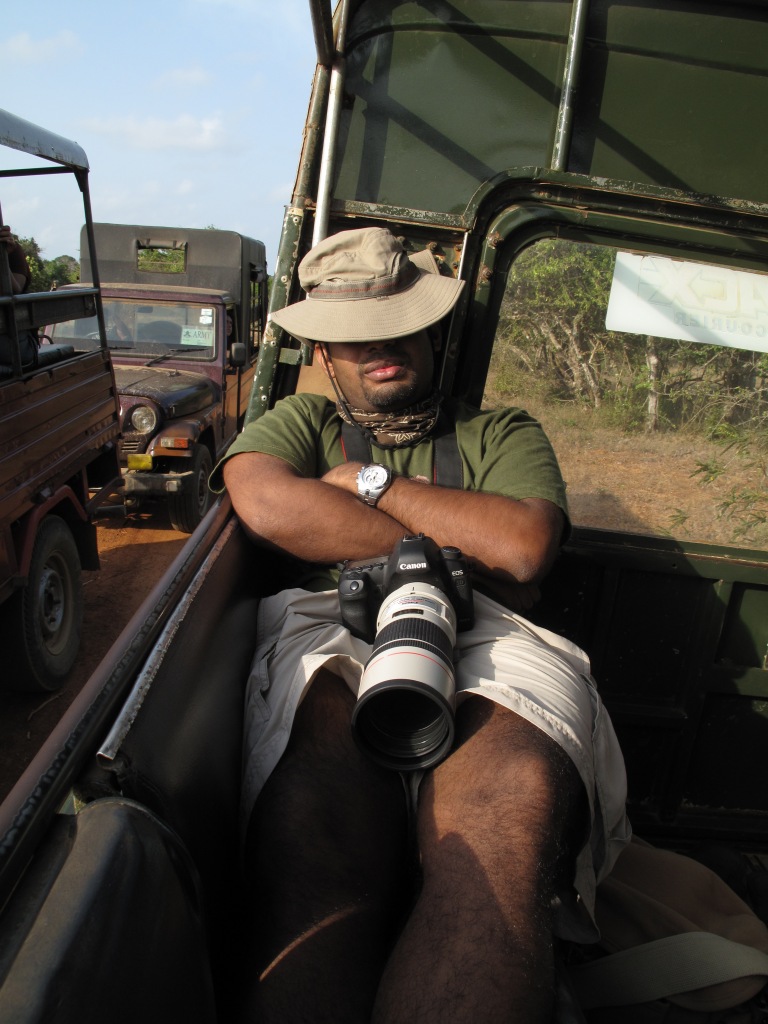
On the outlook (Courtesy PP)

Exhausted as much by the anticipation as by the heat and grueling drive, we called it quits and regretfully left the park, driving through swirls of yellow butterflies that had congregated on the road. Wilpattu, on our first visit, kept her secrets well hidden. As the animals have still not been acclimatized, Wilpattu’s wilds and wildlife deserve many visits and you will have to work hard, very hard for your sightings. Assuming of course the park survives the unplanned depredations that are being visited upon it now.

Butterflies
Butterflies bidding us goodbye

7/30/2010

The Full Tour (Wilpattu, May 2010: Part 2)

 Continued from here:

This being our first time in the park for all of us, we had opted for the complete tour and Chamara obliged very gladly. The Villus of course are a characteristic highlight of the park, Tala Villu, Kali Villu, Maila Villu, Walas Villu, the names rolled of Chamara’s tongue as we passed the golden grass and pure white sands of the small lakes.  Formed by water percolating through limestone rock to the surface, the villus are famed for their birdlife, though possibly due to the park being quite dry we didn’t see too many birds.

Juvenile white bellied sea eaglePipit taking off
One of the many Villus,I cannot recall which one; Wilpattu birdlife

We didn’t see any of the legendary ‘villu elephants’ either, long touted as being the biggest elephants in Sri Lanka. In fact on our whole trip our sightings of animals were few and far between, a Monitor Lizard on its way up the evolutionary ladder, a Barking Deer standing transfixed in the road before dashing off into the undergrowth, two Sambhur watching us warily before spooking and Wild Boar trundling ahead of us. It was obvious that the animals still had a ways to go before getting used to vehicles and people.


Monitor Lizard at attention; Wary Sambhur; Wild Boar on the road

A gloom settled over our little group as we cut across the new ‘Mannar’ road that bisects the park. Chamara was subdued as well as the personnel at the Navy checkpoint were incredibly arrogant as we tried to cross over to the other side of the park. Being used to the good manners of the forces in most other places we were a bit perturbed by this treatment and Chamara seemed to withdraw into a shell as he told us in low tones about how the Navy had started acting like they owned the park. Crossing the new road we came across more brush cleared along the track as we moved towards Kudiramale. Then we hit it, the new coastal road that the Navy had cut along the westward edge of the park. The fresh red earth gleamed like newly drawn blood across an immense expanse that stretched on either side of us. I’m not even sure how to describe what I felt then, just nausea that after all this time, the crown jewel of our parks was finally open but being pillaged at the same time.


Cleared brush; The road cut by the Navy

Our mood was slightly lifted as we stopped at little bay from where we had to disembark and walk to Kudiramale Point, where Vijaya is supposed to have landed presumably in search of somewhere to party. The red soil of the area is linked with the name given to Lanka by Vijaya of Thambapanni. From the bay we walked into the shallow sea and hugged the shore to where we could ascend up the hill. The waters lapped warm and brown against our feet as fossilized coral showed just under the surface. The silence and the immobility of the small bay was a bit unnerving as we picked our way through the water and the twisted trees and we were somewhat relieved to leave the sea and start up the hill.


Walking in the bay; Strange driftwood

Of course by this time it was close to noon and soon our relief was overcome by exhaustion and a general unwillingness to go on. Of course Chamara egged us on up the cliff and we entered an eerie landscape of black heaps of stone that to me looked again like fossilized coral, though others didn’t agree. It was a fascinating experience though and I was as usual drawn to the sea. From the cliffs the waters looked at once quite shallow but a bit unnerving with Ghar fish swimming in throngs in the milky water and rocks appearing and disappearing in the murk.


The sea from the cliffs; Black rock formations

A flash of bright blue alerted us to a rather incongruously new board put up by the Navy explaining the historical significance of the area with laviscous details of Kuveni’s affair with Vijaya. Well I jest but the board was somewhat interesting and I glanced at it for a few seconds before I realized the jeep was nearby along with a much needed bottle of water. And thirst trumped interest in history.


History of the site

Part 3

7/26/2010

A Tragic Park (Wilpattu, May 2010: Part 1)

Wilpattu. The name has always evoked bittersweet excitement for me. All my life it has been my Shangri La for wildlife. I grew up with the tales of family trips of generations and the almost mystical leopard sightings, shining gold and black on the white sands of the Villu’s. Wilpattu is the country’s largest park and arguably the most untouched, its bungalows (when in operation many years ago) were rated the best in the land, all in addition to its reputation for being the top site for leopard sightings in Lanka. As if this wasn’t enough value for money, the park also plays host to sites that are writ large in Sri Lanka’s storied past, including Kudrimalai point where Prince Vijaya is said to have landed and a palace that was supposed to have belonged to Kuveni, the tribal princess.

Wilpattu Jungles

Despite its many wonders, in 29 years I had never been to Wilpattu save for when I was a mere toddler. It didn’t take too much enticement when S called asking if I wanted to accompany them on quick weekend jaunt to Wilpattu. Leaving from Colombo on the midnight run via the A3, we reached our base, the Governor’s Camp bungalow in Wilpattu as a grey morning dawned. Quite a charming bungalow offering good value for money minutes from the park, the lodge can accommodate eight people in four double rooms for the price of Rs.10,000 a night. You can bring your own food or pay extra for food, we opted for the latter and the fare was quite good. The options for accommodation appeared a bit thin at the time with other bases ranging from hotels in Anuradhapura and Kalpitiya. I personally would not advise staying at places that are this far away, simply because it means you need more time to get to the park entrance. And you want to get to the park at the first hint of daylight to get the best wildlife sightings.

The road to the entrance

Things seemed quiet around the park entrance where we rendezvoused with our jeep driver, Sunil for our whole day safari, which set us back a grand total of Rs.7,000. A half day safari would set you back Rs. 4,000 but given the size of the park, unless you are really short of time you want to go for the full days safari. The lines of Safari jeeps you see in Yala were absent and it looked like, despite the park having been open for over two and a half months, it was still not heavily visited. In fact we were to see a grand total of three other jeeps, all venerable old Willis jeeps, during our time in the park over the weekend.

Entrance to Wilpattu

Packing into our jeep we drove to the park office at Hunuvilagama to get the formalities of our visit, purchasing tickets and having a ‘tracker’ (i.e. guide) assigned. Wandering around the office, the neglected state of the jewel in the crown of Sri Lanka’s dry zone parks was apparent. The infrastructure was dilapidated and the exhibits looked forlorn and dusty. Noting a roster of park wardens in the corner I went over for a closer look. I felt an eerie chill as I noted that the list stopped at Wasantha Pushpananda, the warden of the park who was killed by the LTTE in 2007. The board seemed oddly matter of fact, Park Warden, 2003. There was no indication of the violent end this dedicated man had come to in an ambush at Kokkare Villu.

Wardens of Wilpattu

Shaking these morbid thoughts off, we loaded our Chamara, our tracker, a most pleasant and enthusiastic guide and headed off into the park. The drive into the park led through Wilpattu’s signature monsoon forest, venerable Pallu and Weera trees clustered up on either side of the road while sunlight filtered through the canopy which met overhead. Our first sighting of the day was a relatively common Serpent Eagle which decided to fly along the road in front of our jeep. Sunil cut the engine and we coasted along in silence with the eagle escorting us and the sounds of the jungle around us, cicadas shimmering and the musical chiok, chaw-choik calls of the Jungle Fowl.

Chamara, our tracker

Breaking into an open plain we came to the dilapidated buildings at Maradanmaduwa. As we ate a hasty breakfast, Chamara told us about the fateful day on May 15, 1985 when the LTTE massacred a 120 people in Anuradhapura and made their escape through the park, killing a further 19 people in the park. Apparently one of the staff at the park was a survivor of this event and got off relatively lightly with gunshot wounds to the leg. We were later to have another reminder of the park’s grim past as we saw the remains of the jeep that had been ripped apart in May 2006 killing amongst six others, the renowned author Nihal De Silva. Hopefully as the park continues to gain popularity and returns to its former majesty, Wilpattu’s sheen of past violence will wear off. 

Maradanmaduwa buildings

Continued here

7/08/2010

The Green and Black Gem (Sinharaja 2/13/2010)

If you are ever in Sinharaja and you see a small body of water, even something that would be deemed a pond with exaggeration of the highest order, do tread softly. You could be inches from one of Sri Lanka’s most beautiful, endemic snakes, the Green Pit Viper (Trimeresurus trigonocephalus). And you don't want to scare it away.

Emerald green, yellow and burnished black would probably be an adequate description for this little jewel of a snake. I had never seen one until a trip to Sinharaja in February with the Adventure Lanka crew where we saw around three of them near small bodies of water, the snakes entwined in the undergrowth.

Of course these snakes are poisonous, though fatalities apparently have never been recorded, so treat the snake with the outmost respect and you will get some great macro photographs.

7/07/2010

The Small Stuff (Yala 05/06/2010)

The Sri Lankan Big Four. Leopard, bear, elephant, buffalo. Those are generally the animals that are synonymous with Yala. Yet on this trip to Yala I took a few minutes off when we stopped for a rest at the Menik Ganga to take a small break and look out for the small stuff. And the search was surprisingly rewarding, not only in terms of obtaining some pictures of animals you usually don’t associate with Yala but also for getting a couple of more ‘arty’ shots.
The Menik Ganga (River)
(Photo Courtesy of PP)
The first item of interest on the menu was a roiling black mass on the white sands bordering the river. Taking a closer look I was astonished to see hundreds of small beetles engaging in what could be described as an all out orgy. I’m guessing it was a mass breeding of these beetles which happened every now and then and the copulating carabids made for some very interesting macro efforts.
 
Beetle orgy
Wandering over to where the trees overhung some still water, it was apparent that sex was on everybody’s mind as I stumbled upon two mayflies mating. Unfortunately I’m an insect neophyte so was unable to identify the species. The light was also very dim under the canopy so my shots were more abstract than perhaps I would have liked, but then capturing mating mayflies on the move is dim light is no easy task.
Mayflies mating
Leaving the mayflies to their own devices I wandered over to the river and noted the gorgeous colours of the decaying leaves in the water, chocolate browns, dark red and bright yellow, shimmering in the water. Of course since I’m easily distracted I was promptly distracted by an unidentified butterfly that teased me by not settling down for a clear picture apart from a few brief moments.
 06.06.2010

Leaves in the Ganga; Unidentified Butterfly
The icing on the cake for the small stuff was the shy frogs inhabiting a little pool of still water near the dried up bank. I played hide and seek with them amongst the fringe of rootlets dropping into the water to get a few interesting pictures of a somewhat common amphibian.
 
Peek-a-boo Frog; Bolder Frogs


There is of course a moral to this post. The next time you're in Yala, do take a break at the Menik Ganga, do not litter (and pick up what other people have left behind) and take a look around you for the small stuff. Trust me, it's as interesting as any leopard can be.

Note that I haven’t put in the species for the frog and the butterfly in the images simply because I’m lazy to ID them. If anyone does know what they are please let me know! Thank you in advance!

6/23/2010

The grid-locked leopard (Yala, 05/06/2010)

The phone beebed as Sumudu reached over and said he’s customary ‘Kiyanna!’ (translated loosely as What’s up). Looking back at us with a terse ‘Allagane’ we sped up as he drove through the dusty tracks to where a leopard had been sighted taking a snooze in a tree. A breathless ride later we came to a hurried halt in front off not a snoozing leopard, but a traffic jam in the jungle.


Traffic jam (photo courtesy PP)

Don’t get me wrong, I love Yala from the bottom of my heart, but sometimes the crowds can get on my nerves. The engines revving, the fumes and the loudness of the pissed off drivers all can be a bit much. I don’t really care if the leopard in question is doing a tango, dressed in a pink mini-skirt on a Palu tree, I simply have no patience for this kind of thing.


Sumudu trying to get the line moving (photo courtesy PP)

We stayed in line for what seemed an eternity, Sumudu trying to jostle a look see at a leopard that remained obstinately blocked by a bush in front of us. I made the best of a bad time by settling down for a small nap. Which considering the fact I had woken up at 4am was much welcomed.


Time for a nap (photo courtesy PP)

Finally getting to the head, or rather the middle, of the line we could see the leopard, through a haze of intervening branches, rather firmly ensconced on a branch showing no sign of getting up. Rather unexpectedly however it suddenly raised its head, resulting in a shudder of excitement through the audience and a crescendo of camera clicks. It nonchalantly licked itself a bit, gave us a stern glare turned around and went straight back to sleep.

 
Yawn, lick, stare

That was of course, our sign to move on and leave the sleeping, celebrity leopard to its admirers, while we searched on for a more peaceful encounter.


Fast asleep

6/21/2010

Stepping on Snakes (Moneragala Chronicles)

As a word of explanation, I once spent two months living in a little village in Maragalakanda, close to Moneragala back in 2004. My purpose, living there without electricity or running water, was to study bird diversity in an agroforestry scheme for my MSc. This was when the photography bug first bit so there are some tales worth telling and some photos worth showing, though the latter were for the most part taken with a dinky Canon G3. For more of the Moneragala Chronicles click here.

Nuwan jumped off the tree that he had just tied a yellow ribbon to, marking one of our research sites and landed lightly on the rock. He looked at his feet, looked at me initially with no indication that anything was amiss but a split second later his countenance changed. Dare I say he went a bit pale and in rapid succession he did a double take towards his feet and daintily but adroitly stepped aside.

Of course not being one to be fazed by anything, especially anything reptilian in nature, Nuwan excitedly beckoned me over to show me what he had almost landed on. On the rock, amidst the leaf litter lay a perfectly camouflaged, snake. Nuwan’s foot had landed a mere two inches away from its head but it hadn’t moved an inch as it lay there, the pointed snout of its viper head resting on its coils.

Hump-nosed Viper

We identified the snake quite easily as a Merrem’s Hump Nosed Viper, elegantly known as Hypnale hypnale in Latin and the Kunakatuwa in Sinhala. It was a beautiful specimen of what we at the time thought was a relatively mildly poisonous viper. Of course if Nuwan had been bitten it would have gotten complicated as we were a couple of kilometers out in the jungle down a very steep slope in thorny intermediate jungle. Rather spine tinglingly, I found out many moons later that according to two gentlemen by the name of Kularatne & Ratnatunge (1999) in a poetically titled article ‘Severe systemic effects of Merrem’s hump-nosed viper bite’ that the venom can cause acute renal failure and bleeding disorders.

Hump-nosed Viper

Thankfully at the time we were ignorant of these dangers and we simply took some pictures, patted the viper lovingly on the head (I jest!) and made our way back to the research site, being extra mindful of where we kept our feet.