Showing posts with label diving. Show all posts

10/03/2012

Photo of the Week (10/03/2012): Safety Stop


For the beginner diver this is one of the most discomfiting times of a dive, the safety stop, 3 minutes at 5 meters with the aim of eliminating microbubbles which are the cause of the dreaded decompression sickness or the ‘bends’. This can be an embarrassing time and as a beginner I used to flail around sometimes and I’ve even been dragged down by exasperated divemaster.

M0015223

The pro’s make this look effortless, motionless in the water, maintaining their near constant depth sometimes even checking out their photographs from the dive. The trick to getting this perfected is to always check your depth and attune yourself to how your breathing affects your speed of ascent and descent. Being perfectly weighted especially with your empty tank in mind is also essential and with some practice being uber cool during the safety stop is well within reach.

9/03/2012

The importance of a sausage


It could mean the difference between life and death.

No, I’m not talking about the breakfast accessory but what we divers call a Safety Sausage or more technically a Surface Marker Buoy (SMB).  Basically a brightly coloured, balloon made of a thick canvas to withstand some punishment which is clipped to your BCD or in a BCD pocket. This is an essential piece of gear, no matter where you dive and should be something you have even for resort diving.

The ocean is a fickle mistress and unpredictability is something we come to accept as part and parcel of being so intimate with the sea. What you can see above water is only half the picture with currents being unknowns in diving. Currents can pick up during a dive or switch direction even in locations where there are generally well known prevailing currents. If you are not careful with navigation and air management you might not have enough to get back to a line, assuming there is one. On drift dives you could get separated from the main group which makes it tough for a boatman to follow your bubbles. The bottom line is that you could end up doing your safety stop and surfacing away from the boat.


It's a long way to shore from here

Speaking from experience, the sensation of surfacing after a dive to a grey sky and sea, without your boat in sight, can be to put it mildly, a stressful experience. One dive in particular comes to mind, a reconnaissance dive on a new part of Watiya reef in Colombo with Dharshana back in 2010. Swells were huge and the sky overcast as we descended and as we surfaced the current picked up. So much so in the time that we took to ascend and do our safety stop, around 10-15 minutes we surfaced surrounded only by mountainous waves. Luckily as we crested one of the swells, we spied our boat a good half a kilometer away. We quickly unrolled our SMBs, extracted our whistles and started blowing, hoping to attract Uncle Sumathi’s attention. 

Deploying an SMB in heavy swell

Unfortunately as Sumathi’s eyesight left a bit to be desired, compounded by the fact that he was looking the other way, he failed to spot us as we continued drifting inexorably towards Australia. Luckily for us, our SMBs came in handy as a passing fishing boat spied us and informed Uncle Sumathi about our whereabouts.

More than a couple of times an SMB has come in handy and along with a reel for drift dives should be an essential part of every diver’s kit.

8/13/2012

Top 10 Memorable Ocean Experiences of 2011: No. 09 – The Mysterious Wreck


It still seems strange but at the time I dived the huge wreck in Vakarai, it never occurred to me to question what the wreck was, what ship had gone down when to create this paradise? I guess at the time, I was still a relative neophyte, more concerned with fish and photographs. This wreck was the first that really woke my interest in wrecks as more than just fish aggregators and pretty sites.


On our return to Colombo, DJ enrolled me inadvertently in his search for the name and origin of the mysterious wreck. As we scoured lists of sunken ships and coordinates it became apparent that there were two strong candidates for the wreck, both sunk during the Japanese attack in April, 1942 which also sank the world famous Hermes.


The first candidate was one of the ships from the Hermes convoy, the merchant navy ship the British Sergeant which was an oil tanker that had put out to sea that fateful day before being sent to the bottom by the Japanese raiders. I found a rather thrilling story about one of the survivors and the valuable information in it that the ship had split in two before sinking. The ship had also been steaming towards shallower water when it had been attacked. Rather intriguingly two Japanese planes had also been shot down in the attack according to some reports.


The second candidate was a Norwegian ship, the Norviken which had been in the wrong place at the wrong time and had been badly damaged by the Japanese planes . The reports indicated that the ship had run aground near a place which indicated a relatively shallow area as the final resting place of the ship. Confusingly the Norviken had also broken in two before sinking. However the Norviken should have been in relatively shallow water while the wreck we were diving was shallowest at around 12 meters from the top so in at least 18 meters depth of water


DJ had very handily found both the wrecks on the brilliantly named site; WRECK site and this had some excellent information on sizes and weights of both ships. That coupled with some very helpful information from the British Merchant Navy Old Friends Plus forum  with photographs and tonnage, left us with a relatively simple task to narrow it down to one of the two ships. Given the fact that the British Sergeant was double the tonnage of the Norviken it was obvious that it would be bigger of the ships, in fact the width of the British Sergeant was, according to the sites, around 16.5 meters while the Norviken was at around 13.9 meters. We focused on the width more than the length because it would be an easier exercise to measure the width when 20 odd meters underwater than the length which could have been over 100m long.


We departed from Colombo with a clear aim, measure the width and do more photo documenting to try and match the ship to one of the contenders. Leaving at the ungodly hour of 3am we drove straight through to Mankerni, over the Kayankerni bridge to meet Lal, our fixer at Thennadi Bay. Straight from the car we jumped into the boat and headed out to the wreck focused on our mission.


Visibility was excellent as we started, 15-20 meters of blue as we swam along the wreck. An eagle ray flapped lazily past us, surely a good omen of an amazing two dives to come. The first dive was purely for orientation, our last couple of dives here being a few months before and dives which were rudely interrupted by the tank incident.


DJ Swims along the wreck


The first stop was an immense rip in the stern area of the ship, a daunting looking cave that took a bit of willpower to swim into. Slight beams of light glistened on the other side of the cave as we swam in and let our eyes adjust


Underwater cave


 A pair of Giant Trevalley darted into the cave and into the depths of the ship. Leaving the inside of the ship well alone (well I did at least) we swam back to the middle to greet our old friends the batfish. The effects of fishing were evident here as well as nets festooned the wreck.


Crappy photo of the GT


Net festooning the wreck

On the second dive it was down to business. Finding a suitable place to measure the wreck was difficult as with the obstructions trying to find a level place to measure was a challenge. With only one reel we couldn’t take more than one measurement so find a suitable location, I held on to one end of the line at the edge of the hull as DJ swam to the opposite side reel in hand. Visibility at the bottom left a bit to be desired so all I saw after a few minutes was the line stretching into the blue. It was a bit of a relief to see DJ come back rolling up the reel after having carefully made a knot where he had reached the other side of the hull.


Taking our measurement


DJ exploring


On the surface


Getting back to land and our bungalow we carefully laid out the reel and measured out the length of line that corresponded roughly to the width of the ship. We had taken out around 19 meters of line which though larger than the widths we had for both ships seemed to make it much more likely that we were dealing with the British Sergeant than the Norviken. Later on comparing old photographs with those of the wreck, especially around the railings at the bow, the weight of the evidence does lie upon the side of the British Sergeant. The lack of anything in the near vicinity for the ship to run aground also indicated that we had indeed identified the British Sergeant. The photos here are not the best since I was lacking a wide angle lens and to be frank wasn’t very good at this kind of thing yet but click here for DJ’s superb photographs and write up.


Railings on the ship


Elated at a superb day, as the sun set on a beautiful day on the east coast we made a fateful decision. One that would lead to an adventure of sorts that I have never experienced and hopefully never experience again and to us missing out on diving the British Sergeant for the rest of the season. We decided to celebrate by getting a couple of beers.


To be continued…

7/30/2012

Top 10 Memorable Ocean Experiences of 2011: No. 07– Sperm whale at Degalmeda


It was a typically hot surface interval in mid April. The water had been a beautiful blue on the Degalmeda reef and we were getting rid of our excess nitrogen in preparation for heading back down in a bit. Nilanga and I were at the bow while Daniel and Nishan were at the stern having our respective conversations.


Our fearless boatman, Nilanga


It was during a lull in our conversation that I heard what sounded like a set of hydraulic brakes going off in the distance, Nilanga heard it too and we paused and looked northward from where the sound had come. There was nothing but the sunlight glinting off the waves as Colombo wavered in the heat haze. Shrugging our shoulders we returned to our conversation when the sound came again, this time loud enough to draw Nishan and Daniel’s attention as well.


We stared northwards again shading our eyes against the harsh sun. The sound was repeated a third time and this time we saw the spout and gleaming black as the sperm whale spouted about 200 meters north of the boat. This was quite a surprise as you can imagine and unfortunately we spent far too much following the whale’s path in disbelief before we got our masks and fins on.


We quietly slid into the water as the whale came parallel to our boat, the black back and tiny fin gleaming in the sun as the water slid up over my mask. Unfortunately we paid a price for our tardiness in getting our gear on as the current was flowing northwards while the whale was already a bit south of our boat. The three of us, cameras at the ready watched helplessly as the whale powered past us effortlessly, turned westward and headed out to sea. An awe inspiring if somewhat embarrassing moments

2/29/2012

Unidentified fishy object

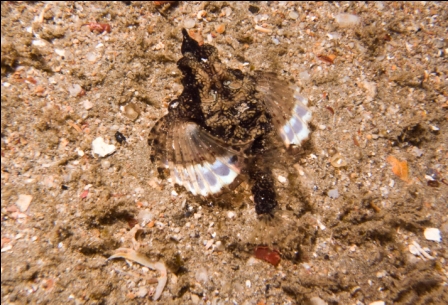
The wonderful thing about diving is that you always come across something strange. A heap of sand with a slivery fish poking its head out, a spurt of sand as a ray darts past you. This however was possibly one of the strangest things I have seen. Out of the 2 meters of visibility on a small inshore wreck in Unawatuna, I spotted a tiny black shape where the sand met the wreck. As I moved in closer to take a look, the shape resolved itself into a small object with what looked like two wings on either side, splayed wide as I came closer.


The shape of whatever it was so odd that I could not figure out what it was, fish or invertebrate. The surge across the wreck made it quite hard to get a good look or take a photo as no sooner had I gotten close to take a look or focused on the creature, the surge swept me past the creature.


Finning furiously and almost standing almost on my head to get as close to it without inadvertently crushing it I noted with some surprise that it looked like an underwater toad, big bulbous eyes and a short snout. To make the creature look a bit more medieval and possibly even more unbelievable on either side were two large pectoral fins, bright white in spots in contrast to the sand and black of the creature. The final touch was a ratty tail that seemed to have been tacked on as an afterthought.


It wasn’t the fleetest footed animal I had seen overland or underwater. It didn’t seem to be able to swim but flip flopped on its ‘wings’ away from me as I endeavored to take a photo, moving only a small distance however before seemingly being exhausted and sinking down in the sand and watching me with its liquid eyes.


We played an odd game of cat and mouse as I tried to get a decent photograph amongst the whirling sand and surge. We must have made an odd site, me finning around furiously standing on my head while the creature waddled along the bottom on its wings going around in circles.


Back on the boat Nishan made an initial identification of the fish being a Sea Moth and after some more research it seems to be Eurypegasus draconis , the short dragonfish though this is yet to be confirmed. Just another dive, just another critter.


2/22/2012

Top 10 Memorable Ocean Experiences of 2011: No. 05 – When Everything Goes Right

It was an early start for ADV (the famous whale researcher) and me. 7.45am and the boat was launched smoothly onto a flat sea. There being just the two of us and Uncle Sumathi in the boat we flew out to sea coasting over the calm waters and arriving at the Taprobane East wreck in a record 45 minutes.

I remember that this was one of the first dives where I navigated solo (with a  GPS of course) to the wreck so was a bit nervous about locating the wreck and hooking it. The first time we weren’t lucky so we dutifully pulled it up and tried again. Second time lucky of course and the anchor was firm. As we descended down the line, the shape of the wreck loomed out of the blue, definite success.

The bright sunlight and clear water made for a kaleidoscopic dive, the soft coral shades of pink, orange and red with the glassfish shimmering over them. A giant moray, green and huge lay stretched out on part of the wreck gaping as we passed over it, giving it a respective distance. The white sand sparkled and then clouded as a shoal of trevalley nosed around digging for food. All of a sudden the shoal, about 30 in number gave up digging in the sand and swam around us. They circled us, swimming round and round in a tight circle with their sleek forms glinting. I would have hated to be a bait fish surrounded by them as the lazy power which with they swam gave hints of the acceleration they could be capable off. Finally they got bored of us and moved back to foraging.

As we rounded the side of the wreck an immense thumping sound could be heard. A tug boat nearby had started its engine and the sound reverberated through the water like a giant tribal drum. With this backdrop a shoal of batfish suddenly appeared, silhouetted in the sun and swimming towards us, almost seeming to swim to the tune of the drum. The shoal swims past us, a tiny golden trevalley rather incongruously leading the fish at the front. Truly a magical moment.

Time was up however and we had to ascend. Uncle Sumathi, his wizened kindly face and bright red shirt apparently suspended in gin clear water as he looked down at us over the side of the boat. Starting back to shore things got even better. A flying fish breaks the surface, whizzing over the flat sea as a barracuda breaches after it. The flying fish goes far but the barracuda, unsuccessful flops down into the sea.

The icing on the cake was a pod of feeding dolphins breaking the surface. We quietly slip into the water and move towards them hoping they will swim past us. We can see them at the water level, breaching and breathing as they hunt. But they stay tantalizingly out of sight and we are left to enjoy the warm Indian Ocean, floating carefree kilometers from shore yet still at home.

2/08/2012

Top 10 Memorable Ocean Experiences of 2011: No. 04 – A Blue Day at Degalmeda

You tend to associate blue water and crystal clear waters with the outer reefs in Colombo. The bone crunching hour plus long boat rides in the tiny boats and the surface intervals in the blistering sun. All for a few brief snatched moments of bliss in the big blue. You anticipate those days with the seemingly unending miles of visibility but are wary of them at the same time knowing you will suffer, suffer willingly but still suffer.

This day on Degalmeda was different though. As I took the anchor off the rock and moved it to the sand I looked up and the vista was breathtaking. The anchor rope stretched a light blue against the canvas of the ocean waters. In one fell swoop I could see the reef, the two accompanying divers and the boat almost appearing to float magically above us with light shards dancing around us. This just a 20 minute gentle boat ride from the shore without any of the usual punishment and in November nonetheless!

The perfect dive, lots of things to photograph, blue water, zero current and accomplished buddies a hop, step and a jump from Colombo’s shores.

2/06/2012

Photo of the Week (02/06/2012): Bait ball action on the Medhafaru


Ok, it's not the best image (by any stretch of the imagination), but this was my 200th dive, I was in intense pain with imploded sinuses and int he middle of a baitball with tuna and seer hitting it. I completely forgot to switch my camera to AV out of Manual but I did get this one shot that showed some recognizable fish.

1/30/2012

Photo of the Week (01/30/2012): Pro Divers

There is nothing better than to dive with a group of accomplished divers. A dive group consisting of Divemasters and Instructors displaying perfect buoyancy during an ascent from a deep dive to 36 meters on the Gorgonian Gardens off Colombo.

M0013776

1/24/2012

Top 10 Memorable Ocean Experiences of 2011: No. 02 – Operation Rescue at Medhafaru

DJ and I had seen the net stretched taut on the crane like structure on the Medhafaru the last time we had dived and we knew it meant trouble. Sure enough on the next dive at the wreck, as Nish, Keerths, Daniel and I started our dive; the first thing I saw was an outline of a large fish, seemingly motionless next to the crane.

Swimming closer the silhouette resolved itself into a blue-line grouper that was hanging off the net by a loop that had effectively created a noose. You could see where it had tightened as the fish had fought, white flesh showing through the blue and green skin.


Initially it was hanging so still, swaying quietly in the surge that I thought it was dead but as I got right up next to it, its fins flapped and it tried to feebly get away. The nylon on the net was wrapped tight and taught against the fish. These groupers have a habit of lying in wait for prey and then shooting out at them and it looked like this fish had picked a very bad place to set an ambush, running right into the net. The net itself was knotted tight presumably by the fish twisting trying to get away from the encumberance.


It was strange to be quite so close to one of these fish as they are generally quite shy and only give you the briefest glimpse before hiding away in the shadows. Up close and personal the fish was quite magnificent, shimmering green and luminescent blue. The only thing that marred the picture was the bruised flesh around the net and the look of terror on the fish’s face. I never really thought that fish could look scared but the fear was palpable when looking at it.


I pulled out my knife and tried to figure out a way of cutting the grouper free without damaging it even more but the camera made things awkward. Calling Keerths over, I motioned for him to take the camera, tightening the lanyard around his wrist for safekeeping.

Things were still a bit tricky as I slipped the knife gently between the fish and the net strand, the fish’s body oddly pliant and fragile. The net tightened on the other side of the fish as a result and flesh and blood drifted off making me even more cautious. Every time I brought the knife up to cut the fish struggled and the water clouded with blood. After a couple of tried I started to wonder if it would be more merciful to kill the fish instead of putting him through the slow pain of a botched release.

I finally managed to slip the knife up towards the fish’s dorsal fin and gritted my teeth and pulled. With a snap the line parted and thankfully only a bit of blood was released. The fish hung motionless and free for a moment. Then in a moment it realized it was free and the body swung as the fins powered up and in a flurry of movement it was gone. A lucky survivor of the ghost nets that plagues our shipwrecks.

1/23/2012

Photo of the Week (01/23/2012): The Trug

The propeller of the tug boat wreck fondly known as the Trug. Home of curious Lionfish and a superb swim through filled with glass fish.

M0010576

1/16/2012

Photo of the Week (01/16/2012): Divers on Taprobane East Wreck

Two divers explore the Taprobane East Wreck, one of our favourite wrecks on the outer reefs of Colombo. This day was a bit murkier than usual with about 15 meters of visibility instead of the usual 20-30m.

M0012908

Read more here.

1/09/2012

Photo of the Week (01/09/2012): Curious crab

A curious crab peers out from a crevasse on Degalmeda reef.
M0010262
You can often see these crabs skittering away into the shadows as you approach so getting a good sighting of one is difficult!

1/04/2012

Top 10 Memorable Ocean Experiences of 2011: No. 01 – Swimming with a Flatworm

It’s 2012 and I’m looking back on a 100 dives in 2011 and 200 since I started diving way back in 2009. Since this was my first full year of diving with somewhat reasonable dive skills and a camera, I figured I would put down some of the most memorable dives/events that I have had the privilege of experiencing during the season.

Of course a lot has happened so expect a multi-part post with the events in no particular order of significance.

I will start of with a characteristically geeky event, my brief if surprising swim with Thysanozoon nigropapillosum which rather less jawbreakingly is known as a Polyclad flatworm. Usually you see these vivid black and yellow flatworms innocuously sitting on the rocks on shallow reefs such as Palagalla so I have come to associate them with brown, murky water and silty dive sites. I did see one launch itself for a brief swim, undulating gracefully through the water so I knew that they were quite mobile as well.

Thysanozoon nigropapillosum sitting pretty on a reef, confident that no-one is going to try and pronounce its name.

The fateful dive was just like any other on the Taprobane east Wreck, a long boat ride with the fresh sea air waking you up from a groggy early morning start. Anchoring onto the wreck we dropped down quickly to the site. Being at 30m and a flat profile we didn’t have much time until our bottom time was used up so I moved away from the rest, looking around at the bright corals and dazzling fish, eager to try out the relatively new camera.

As I swam over the main section of the boat, the hollowed ribcage of the wreck encrusted in bright colours, a spark of movement caught my eye. Glancing down I was…taken aback would be a good word to use I guess. Of all the most incongruous things to see on this site, it was one of these flatworms swimming along with me just skimming the wreck. I have never before or since seen a flatworm on such a deep site (but then we know so little about these sites that’s not saying much) so was flabbergasted.

I realized a bit too late that this was a superb photo opportunity and fumbling with the unfamiliar controls I tried to take a picture. I’m not sure if it sensed me somehow but the flatworm promptly did a nose dive with me rapidly following it. The flatworm swam down through the wreck onto the white sand while I tried to take as many pictures, sticking my hand down through the twisted metal as far as I could.


The flatworm comes in to land

This is unfortunately the only semi-decent photo I managed to take which was an inevitable back shot, quite dark and required a fair amount of photo shop to salvage.


The memory was quite memorable though, looking down and seeing the flatworm swimming along, black and gold against the coral encrusted wreck. Beautiful and completely unexpected.

1/02/2012

Photo of the Week (01/02/2012): Happy New Year

Since I don't have much time to blog regularly these days, I've decided to do a small showcase of my underwater photography.

Happy New Year! I hope everyone had a good start to the year!
M0011915
A shy Blenny on a reef in Colombo (probably a colour morph of a bi-colour blenny)

Equipment used: Sea & Sea DX-2G

12/05/2011

Kraken’s Gaze


The now familiar outline of the Medhafaru wreck appeared out of the blue-green waters, the bridge tilted at a Pisa like angle with the glass still intact though black with algae. DJ moved off to the front of the wreck as I stayed at the back, my more conservative Suunto demanding that I remained relatively shallow for our second dive of the day.

One of the regular denizens of the wreck, a greenish yellow moray, a species we still have not been able to identify, poked its head out a small structure on the deck. It stared out, clenching its jaws repeatedly, as all morays are prone to doing. This does give these eels quite a vicious look especially with their jagged teeth but apparently all this gulping is just to help circulate water over their gills. It’s still not advisable to go sticking any body parts you are fond of near a moray; in fact that’s a good general rule with pretty much any animal.

Best to stay clear of those teeth

Unfortunately I was experiencing some issues with my camera on this dive with the lens fogging up. Giving up on my efforts to get a pleasing portrait of the eel I turned back to bridge. And that was when I noticed it. It was hard to miss actually. Part of the ship was glowing, first white, and then black, then back to white.  Intrigued by this and slightly concerned that I might be suffering narcosis at the unlikely depth of 15 meters, I decided to investigate.

Cautiously getting closer to the object I noted with some relief that it was an octopus, apparently enjoying a Saturday morning lay down sprawled on the ship with his tentacles spread. On seeing me approach, he decided he had better cut his siesta short and backed out and up in between a staircase running down the ship.


Gimlet stare

Safely ensconced he turned a gimlet eye onto me and glowed red again. Unfortunately with the camera issue and a nosy (Scorpion?) fish getting in the way, I could only get a few shots of his eyes. Eyes which were quite eerie I must say, red with a bright black pupil. Eyes that looked as if the octopus was suffering from a virulent hangover and/or possessed by a demonic influence.


The nosy scorpion fish


Mesmerized by the glare I was getting, I just barely registered movement out of the corner of my eye. As usual on the Medhafaru where fish life is prolific, a group of Jacks streamed past me followed closely by a hunting Giant Trevalley who was so intent on securing its meal that it almost headbutted me in the process.  The octopus took this rather exciting interlude as an opportunity to make a getaway back into the deeps of the ship. As I turned back all I saw was a tentacle retreating into blackness  leaving me to hang by the bridge enjoying the hunting shoals of fish over the wreck until my beeping computer reminded me it was time to return back to the real world.

11/27/2011

10 Minutes

Is generally all you have at 36 meters before your bottom time runs out. At 36 meters you are under 3.5 atmospheres of pressure. This means that your ears will pop like crazy as you descend and more importantly you will use your air correspondingly quicker. Your bloodstram also will absorb nitrogen faster at greater depths, and you become saturated with nitrogen (for a super analogy check here. Coming up too quickly in such a situation will cause the nitrogen to bubble out of your blood stream like a coke bottle with its top removed. This is mildly unpleasant to say the least, leading to the dreaded ‘bends.’


The combination of faster air consumption and nitrogen saturation means going into decompression on deep dives is especially dangerous as you run the risk of breathing your tank dry during an extended decompression stop. For the uninitiated this is the period of time you spend hanging at around 3-4 meters of water while the absorbed nitrogen leaves your system. Not a fun thing to do when you have many minutes of hanging around while worrying about running out of air and trying not to pop to the surface inadvertently (the effect on one's sinuses also leaves a lot to be desired). 


Unwise amount of ‘Deco’


At 36 meters however and about 30 minutes by boat lies an underwater garden, huge Gorgonian sea fans dotted on a sandy plain swept by strong currents. The presence of the fans means that dropping an anchor is a no-no. You basically have to throw yourself off the boat some meters up from the GPS point, grab your camera from the waiting boatman and swim down as quickly as possible, trying to keep yourself oriented in the right direction, keeping an eye on your buddy(ies) and equalizing frantically to prevent your sinuses from imploding. Of course all this time you have to keep an eye on your gear to make sure everything is working properly. Needless to say this is complex and this site is only for the experienced diver.


DJ behind a fan, should give you some idea of the size of the Gorgonians


Once you hit the bottom you have to find your photographic subject. For those with wide-angle lenses and dual strobes (i.e. DJ from Divesrilanka.com and Nishan from Seas of Serendipity) the subject matter is often the fans themselves. These with the camera metered for the blue background and the strobes providing fill flash, make beautiful subjects.


 A wide angle shot courtesy of DJ (Divesrilanka.com)


For a macro head like me (mostly due to the limitations of the DX-2G rig I carry), the subject are the coral gobies on the fans. Usually you find these gobies on whip coral on the shallower reefs but singly. At the Gorgonian Gardens however some of the fans have a few skittish gobies to keep me busy. I have made a few attempts at wide angle and possibly will do some more soon.


The first goby I photographed at Gorgonian Gardens. He seems a bit surprised.

 Recent wide angle effort (no colour so no good)


The challenge of taking photographs in these conditions however does sometimes make land photography pale in comparison. You have to maintain your breathing to make sure you are neutrally buoyant and not go crashing into the fans, you have to ensure your fins are out of the way for the same reason, you have to keep an eye on your bottom time, an eye on your buddy(ies) and fight the surge to stay in one place.


This is of course before you actually find your subject, then spend some more time finding one that stays in one place long enough to take a picture, meter the image, figure out your exposure, strobe position, etc to make sure you’re getting a workable image.  Needless to say this is challenging. And it is frustrating after you find a willing fish to hear your computer start beeping after a few frames.  You can only ignore the beeping for a couple of minutes before having to accept common sense and leave the gardens for another time…on the bright side there will be another time.
 M0013613
Last Friday’s workable image.