Showing posts with label adventure. Show all posts

6/23/2010

The grid-locked leopard (Yala, 05/06/2010)

The phone beebed as Sumudu reached over and said he’s customary ‘Kiyanna!’ (translated loosely as What’s up). Looking back at us with a terse ‘Allagane’ we sped up as he drove through the dusty tracks to where a leopard had been sighted taking a snooze in a tree. A breathless ride later we came to a hurried halt in front off not a snoozing leopard, but a traffic jam in the jungle.


Traffic jam (photo courtesy PP)

Don’t get me wrong, I love Yala from the bottom of my heart, but sometimes the crowds can get on my nerves. The engines revving, the fumes and the loudness of the pissed off drivers all can be a bit much. I don’t really care if the leopard in question is doing a tango, dressed in a pink mini-skirt on a Palu tree, I simply have no patience for this kind of thing.


Sumudu trying to get the line moving (photo courtesy PP)

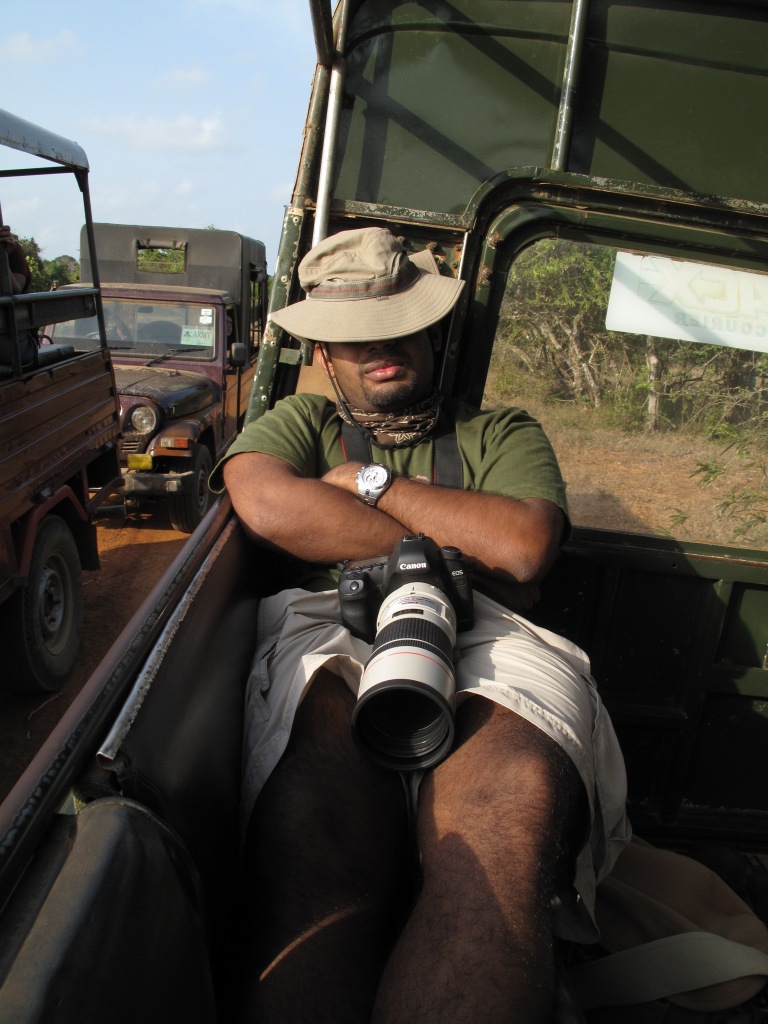
We stayed in line for what seemed an eternity, Sumudu trying to jostle a look see at a leopard that remained obstinately blocked by a bush in front of us. I made the best of a bad time by settling down for a small nap. Which considering the fact I had woken up at 4am was much welcomed.


Time for a nap (photo courtesy PP)

Finally getting to the head, or rather the middle, of the line we could see the leopard, through a haze of intervening branches, rather firmly ensconced on a branch showing no sign of getting up. Rather unexpectedly however it suddenly raised its head, resulting in a shudder of excitement through the audience and a crescendo of camera clicks. It nonchalantly licked itself a bit, gave us a stern glare turned around and went straight back to sleep.

 
Yawn, lick, stare

That was of course, our sign to move on and leave the sleeping, celebrity leopard to its admirers, while we searched on for a more peaceful encounter.


Fast asleep

6/14/2010

Wrestling elephants in Kaudulla

As some of the foreign elements of the family had come down for a flying visit to the homeland we did a rather hectic jaunt to the cultural triangle including Sigiriya, Ritigalla, etc and decided to get some wildlife in by visiting Minneriya. Notably I had never been to Minneriya to see the 'gathering' so I was quite excited. We rolled into Sigiriya village, rented a jeep from the hotel and headed out to the park in the early evening.

As the jeep hurtled over the potholes, my aunt got progressively mystified, as in her experience, Minneriya had been a lot closer to the hotel than it seemed now. Talking to the jeep driver, the mystery was cleared up when it turned out that despite our request, we were heading to the nearby Kaudulla park instead of Minneriya. Apparently because given the time of year (July), Kaudulla was a better place to visit to see pachyderms as the gathering still hadn't taken place in Minneriya.


Jeep entering the park

Rolling into the park, we all stood up in the jeep in anticipation. Initially we were greeted primarily by cows, grazing at the border off the tank. Not the most exciting of animals to see. Things however brightened up shortly afterwards with the appearance of a lone male elephant obliviously eating close by to the road. As we nervously sidled past, the elephant didn't move a whisker (if he had had whiskers that is) and instead studiously ignored us. It then proceeded to put on a 'hat' of some foliage and wandered off towards the waters edge, perhaps to quench its thirst or take an afternoon dip.


Wearing a green cap, he wanders off

A few minutes later though and a bit of a distance away, another elephant turned up. And he was a bit more peraly as my aunt out it (i.e. more frolicky, would be the best translation I guess).


Frisky elephant

This was where the behaviour of some of the park visitors began to grate. One jeep with a lone photographer drove straight up to elephant and began to bait it. Another jeep full of Italian tourists started to yell at the elephant. The humans became the uncivilized lot while the elephant thankfully retreated back into the bush. It looks like our protected areas are protected only in name and the visitors simply have no respect for our great outdoors.


Elephant baiting

The lack of empathy the Italians suffered from had to be seen to be believed. Previously when we were buying tickets to enter the park, a couple of round, lobster red tourists wandered straight past a tame(?) owl that was seated on a post by the walkway to the office. Obviously so un-attuned to the natural world that they didn't see a great big owl taking a break within a few feet of them. Thankfully the owl wasn't too fussed and instead pointed his back at me as soon as I pointed my camera at him. The golden rule of wildlife photography that is, all animals feel their posterior is the best part to be photographed.


Owl backside; Owl peeking

Anyways back to the elephants. After the antics of the parkgoers we moved on further into the park and that's when things got truly magical and surreal. Four adolescent male elephants turned up and proceeded to put on the Circu du Soleil of elephant performances. Testing each others strengths out, they wrestled each other, trunks twisting, legs heaving and even biting each others tails. At one point, they formed a rugby scrum, two versus two and pushed at each other. Obviously trying to get points for originality they even fought over tree branches, which were still attached to the tree.


Wrestling elephants part one

I was enchanted and furiously clicked away at the elephants. In fact I was so engrossed I hit someone in the jeep in the head with my lens quite solidly. But no matter because the lens came to no harm.


Wrestling elephants part two

As the sun set, the four elephants were still at it and we had to regretfully take their leave. Almost on queue as we bounced away over the grey green grass, as we looked back, the elephants merged back into the forest, blotting out from our view as the light fell like a curtain over their performance.


Eastern Grey Heron at sunset

6/11/2010

Hunters in the shallows

I finned out to where the water depth increased to around 3 meters, still getting used to feeling of being so lightweight sans the usual scuba tank, weights and other paraphernalia. Even inhaling was vastly different, so silent through the snorkel as opposed to the usual clatter of the regulator. The early morning sun warmed my back as I floated above a prolific garden of coral.

The branched corals however looked oddly bleak, deserted, as if the myriad inhabitants knew that something was afoot. After peering into the blue distance for awhile without any reward, I took a quick skin dive down and as I skimmed over the coral, it was there. One minute what was an empty blue space was suddenly occupied by the streamlined, gun-metal grey of the world’s best adapted predator. Like a wraith it had appeared out of the blue, a Black-Tip shark. Unfortunately the commotion I caused with my dive scared it off and it retreated as quickly as it had turned up.

Chastened by my lesson in patience, I came back up to the surface and hung there hoping I hadn’t scared off the shark. The coral lay silent once more while the snorkel hummed as I breathed in and out, the blue water still empty.


Suddenly, in between one snorkel breath and the other….they were everywhere. The pack had arrived.
Images courtesy of Dharshana Jayawardena (Dive Sri Lanka)
The sharks weaved sinuously through the water; initially two of them right in front of me caught my attention. A movement out of the corner of my eye, another shark to the left skimmed over the reef while more swam in the distance, shadows in the blue yonder. The inhabitants of the coral reef had been in hiding for a very good reason. The one thing that came to mind as the sharks swam, soaring over the coral, was purpose. They looked to be in hunting mode, effortlessly gliding through the water.
Images courtesy of Dharshana Jayawardena (Dive Sri Lanka)


Some of the sharks were incongruously followed by the bright yellow and black Golden Trevalley, shivering their fins at high speed in order to keep up with their chosen host. I watched as one Trevalley take a break down to the reef to scoop up some invisible morsel. You could almost hear it cursing to itself as it came up off the reef in a flurry almost having missed its shark, which obliviously swam on.
Images courtesy of Dharshana Jayawardena (Dive Sri Lanka) 

An indescribable feeling of awe overcame me as the shark pack swam around me, the perfect predator, a pinnacle of evolutionary magnificence that has not changed for millennia.

Images courtesy of Dharshana Jayawardena (Dive Sri Lanka)

I also felt hugely privileged. This was a sight that not many people will see. Overfishing has depleted shark populations in Sri Lanka hugely. The fishing both for consumption and more insidiously for the fin export market in China has reduced these magnificent creatures to a fraction of their original abundance. A similar campaign against leopards would have raised the ire of conservationists and the public in multitudes. Unfortunately the misunderstood nature of the shark and our lack of understanding of the ocean have led to the mass murder of sharks and the loss of one of the most magnificent animals in the seas surrounding us.

Say NO to Shark Finning!

6/09/2010

Rained out (Gal Oya Part 4)

Continued from (Part 1) (Part 2) (Part 3)

Did I mention it was raining? Well it was and showed no signs of letting up. As we huddled under the tarp, making some feeble attempts at sopping up the tents, one of the more astute members of the group noted the river. Where there had previously been a somewhat small rapid shooting frothy white through the rocks, there was now what looked like the Limpopo in full blast. Brown water with vestiges of white foam shot through the rocks with frightening energy as the water swirled up the tree trunks that had previously stood high and dry. The sand bank on the opposite bank, which, with its rock face backing had seemed such an ideal camp site was now washed away.

Given the impending prospect of being washed into the Senanayake Samudra, kitchen table and all, we discussed our options, namely:
a)    get the hell out of there and go crash at the park office
b)    batten down and stay, hope the rain stops and the river doesn’t rise any further.

One would think that given the situation option a) would have been the natural choice. But, being the adventurers that we are, it was quite a lengthy debate we had on what to do. Eventually sense prevailed (not due to any contribution from me, I was quite down for hanging around to see what happened) and we decided to break camp and move out. While setting camp had been relatively simple, breaking camp was anything but.

By this time we were all miserable and soaked to the bone and tired from the hike. Untying ropes, folding tents with sand sticking everywhere and carrying heavy boxes up to the cabs almost incapacitated us...but we plugged on. Once again the tracker showed his true worth by not helping in the least bit. We decided not to tip him after our trip and to instead charge him for our meals due to his helpful demeanor. Gehan made him carry our ablution water bottles though, as an elegant final touch.

Packing the cabs was just the beginning as heading back out to the office we discovered that the piddling little streams we had splashed across in our mighty four wheel drives had now turned into reasonably significant bodies of water. The water was a murky brown amongst the jungle trees and there was no telling what the depth of the water and mud was. Thus we were treated to the sight of grown men holding each others hands and fording the river to check the depth. Unfortunately I had packed away my camera at the bottom of my gear bag to keep it dry so couldn’t record these images for posterity.

For the most part, the streams were pretty shallow and devoid of mud so didn’t provide much impediment to the cabs on four wheel. There was one moment where we all had our hearts in our mouth, where turning a corner it appeared the entire road had become a river, with a couple of trees fallen across it. Thankfully this turned out to be an optical illusion as the road actually swiveled off at right angles to our initial turn and was in quite good condition. We chugged across the last stream and breathed a sigh of relief that we hadn’t been marooned.


Fording through the jungle (note these images were taken the next morning as we were leaving the park)

On our way to the office we took a break to check out a collection of smooth, round, black rocks that were all that was left of an ancient road that apparently had stretched from Ruhuna to Pollonaruwa back in the times of the kings. The road would have been quite wide, enough for two modern vehicles to pass and it was amazing that it still remained in some shape or form (unfortunately no pictures again). We pondered for a bit if even back in those days anybody took a 10% commission for building such roads and then, mildly depressed by the reminder of the situation in the country, we headed back to the relative safety of the Department office to, after an eternity of being damp, enjoy the unbelievable luxury of some dry clothes.

It seemed like our Gal Oya camping adventure had ended but we made the best of it by enjoying the idyllic location of the department office. One of the best parts of a trip out of Colombo is of course the company, so we cracked a couple of bottles of wine and sat around telling tall tales of jungle trips of the past as well as some more earthy and inappropriate stories. Further entertained by a scorpion dropping by to say hello, we drank until we were dry and retired to the rather precarious tree house for the night, noting that we should probably check the weather report before coming to Gal Oya next.


The precarious tree house; Unwelcome visitor

6/07/2010

Walk to Makara (Gal Oya Part 3)

Continued from (Part 1) (Part 2)

I woke up bright and early to take some landscapes from our campsite. Unfortunately the sun didn't have the same idea and it was a decidedly overcast and damp day that I woke up to. While the rest of the camp slumbered I wandered down to the river, camera in hand and amused myself by stopping my aperture down as much as possible and taking some long exposures.

Sleeping camp; Gal Oya river at dawn

Once enough people had woken up to provide some sort of rescue service in case of wild animal attack I wandered out of camp for some ablutions and then met up with everyone else for a morning river bath. Dry zone notwithstanding the Gal Oya is pretty damn cold early in the morning and rain appeared to be in the air.

Following a late breakfast we powwowed as to what to do, finally deciding on a small walk to Makara, about a click from the camp site to where the river exits into the mighty Senanayake Samudra. A friend of mine (whom I have no reason to disbelieve) told me that the site was called Makara (i.e. dragon) because the water coming out of the rocks at certain times of the year looks like it’s coming out of the mouth of a dragon.

The initial part of the hike was through some beautiful forest, ethereally lit by the sunlight filtering through the canopy to dapple the litter strewn floor. The tracker rather sternly told us that if he told us not to move, to please follow his instructions in order to avoid having a bear tear our heads off. He then promptly forgot that there were two small kids in our group and was miles ahead of us during the whole hike, which was again...a bit disconcerting. As we clambered through the dark gallery forest, roots twisting blackly across our path amongst the tumbled rocks, the forest was eerily quiet. No bird life was apparent due to the overcast conditions, just armies of insects marching their way through silently, occasionally taking a detour over us.

 
Through the forest; Over streams

A light gradually filtered through the forest and we could see a bright break ahead of us through the all encompassing foliage. We emerged out of the forest and stepped out onto some rocks by the border of the river, blinking and trying to adjust to the light. Vast sandbanks petered down to the muddy water as we watched a juvenile white bellied sea eagle fly into the jungle. This was the Makara area but as the river was pretty high it was just water flowing over rocks as opposed to under them.


Makara rocks amidst the river

Apparently during the dry season a stadium of sand forms where you can camp and then walk to the Senanayake Samudra to see elephants. The landscape was still quite beautiful if a bit imposing, the brown river snaking through gigantic boulders while we walked precariously close to the edge. A slip and roll down the sandbank and the only option I could see of getting back onto land was swimming into the reservoir and to the bank. A prospect I looked upon somewhat dimly due to both the unfriendly nature of the river and the definite presence of crocodiles of an indeterminate size and disposition in it.


The lazy tracker

It was then that it started to drizzle and half the group (rather wisely headed back). We of course voted to keep heading out crossing some treacherous sand dunes and slippery rocks. We finally came to a point where it became impossible in the wet blustery conditions to continue without breaking at least a few bones. There we soaked for a bit, huddling into some rocks, trying to wait out the rain and then once the rain seemed to lighten started heading back. The incessant rain had made the walk back even more treacherous and small streams we had hopped across were now mini rapids. We amused ourselves on the way back by falling down a couple of inclines where the soft earth had turned into gooey mud, all the while acutely conscious of what the damp maybe doing to our camera equipment.

Stumbling back into camp, soaked (having disturbing visions of a puddle of water in my camera bag soaking everything) to the bone we hastily unloaded and started drying off. Thankfully some t-shirts in my bag had managed to soak much of the water but our tents hadn't been so lucky, having leaked rather extravagantly.


Sheltering from the rain

After cleaning up our camera gear and drying the tent to the best of our abilities we decided to clean ourselves off by jumping into the river. We noted with some interest that the water had increased in level as the rain continued to pour down, where the water had been gushing over the rocks, it was now more of a cataract, white flecked and angry brown.

5/24/2010

Dive Log: Parak Gala & Cargo Wreck (13/03/2010)

Dive #41 and #42, diving off Mount Lavinia with Colombo Divers, Boatman Ravinda, Divemaster Jehan, and two American dive buddies whose names I cannot recall (as usual).
 
Parak Gala: Bottom time – 43 minutes; Depth – 22.1 meters

Snap! I stared disconcerted at the severed strap of my dive mask. A number of profanities raced through my head as I realized I had left my spare strap on land, in my backpack. The conditions were extremely rocky with white flecked grey waves all around us and there was no chance of getting back to shore to get my strap. Thankfully there was an extra mask in the boat and despite the bad fit I pulled it on and got into the water.

There I was made to wait for what seemed like an interminable time while the waves playfully slapped me in the face and smacked me up against the boat while my erstwhile dive buddies took their own cool time getting ready. Finally all geared and ready, we started to descend. Unfortunately the older of the American couple hadn’t dived for a long time and took all of Jehan’s and the other buddy’s help in getting down. I in the meantime amused myself by standing on my head while being treated to the amusing spectacle of Jehan riding on the back of the American guys tank to help keep him down.

Unfortunately the long hiatus from diving and the challenging conditions with a visibility of around 3m was too much for the American guy and he had to surface with Jehan supervising while the other lady and I were left below to complete our dive (she was a trained instructor as well). We had come to a new dive site to try it out but all we could find was patchy rocks amongst the sand. Since the reefs off Colombo ran north to south paralleling the shore we tried swimming in those directions to see how our reef lay. To my dismay it seemed like we had missed the reef all together and ended up on some random rocks.

Undeterred we explored the five or so small rocks that lay muddy brown on the bottom and were treated to an amazing amount of diversity in marine life amongst the nondescript bottom. My dive buddy spotted a Brittle Star http://www.aquaticsworlduk.com/images/T/brittlestar-01.jpg that was a wondering on the rocks, moving its feathery tentacles as it sought a refuge during the day. A few small white and black nudibranches, Phyllidiella zeylanica and Phyllidiopsis phiphiensis  glistened in the silt, the size of my fingernail and almost impossible to spot. My mask was fogging up and extremely uncomfortable still but we still managed to spot a small juvenile Giant Moray, its jaws slender and sylph like in contrast to the brute strength they would personify when grown up. Also wonderfully camouflaged were two juvenile Scorpion fish, their brown tendrils matching the silty rocks to perfection. Actually this last was quite disconcerting as always, one touch on an innocuous piece of the reef could lay you up in hospital in excruciating pain.

Chastened into remembering to always be an aware diver, we wound up and fought through the chop back onto the boat.

Cargo Wreck: Bottom time – 46 minutes; Depth – 29.6 meters

We dropped the American couple back on shore because of a meeting they had to go for and Jehan and I headed out back to the Cargo Wreck. The weather had deteriorated somewhat and the chop was even stronger. Anchoring onto the wreck it was apparent we would have to descend in a strong current which whipped at my mask and reg as we went down the line hand over hand.

Getting to the wreck we were greeted by around 4m of visibility and as we swam down the ghostly ship, an etch in the blue ocean we were greeted by a huge sand patch that the current had pushed out from underneath the ship. You could see the swirl of water coming through and pulling Snappers under and over the bottom of the ship. Noting that it would be quite unpleasant being stuck under a shipwreck we moved up the ship out of harms way. Jehan took a small break to swim into the ship a bit while I hung around and watched him swim around for a bit from a porthole. We then swam into one of the huge cargo holds and hung there in the semi-darkness, watching what looked like gigantic Snappers and Wrasses swimming around a few meters away from us. The gloom meant we could only see a distant silvery shimmer in the blackness as the fish moved around. A spooky experience which was heightened by the fact that I was again having issues with the uncomfortable replacement mask (I had left my extra strap at home).

Swimming out back into daylight with a sense of relief we were surprised to see three very large Porcupine fish hanging out by the mast, a new site for me as the ones I had seen before were usually fairly small and down at the bottom of the wreck. To top off what was undoubtably an eerie dive, we took up the anchor and left around 5m of line so we could maintain our depth during our safety stop.


With the anchor off the bottom, the boat was pushed along with the current and it was an eerie experience to hang on, the water seemingly whipping past us, blurrily blue as we hung in the middle of the giant expanse of the ocean. Quite a humbling experience actually, on how small an individual really is in this big blue planet.

5/18/2010

Dive Log: Cargo Wreck & Barracuda Reef (12/03/2010)

Dive #39 and #40, diving off Mount Lavinia with Colombo Divers, Boatman Ravinda , Divemaster Jehan, and instructor Shaf.
 
Cargo Wreck: Bottom time – 44 minutes; Depth – 31 meters

This was a dive with a couple of old hands at the game, Shaf and Jehan, and the plan was to spend as much time underwater as possible without going into ridiculous deco times. As we hit the wreck, bait balls boiled out of the blue, Fusiliers exploding past us as they surged silvery in the water. There was more of a current than usual hence the activity of the Fusiliers. On the body of the wreck there were the usual suspects roaming around, a school of Blue-lined Snappers, a phalanx of blue and yellow swimming along.

Shaf peeled away from us to go explore the innards of the wreck (please note that wreck exploration and solo diving requires very specialized training and as such should only be done by suitably qualified divers). I finned down to one of the lifeboats lying disconsolately on the bottom, ghosting the sand. Even this small rusted hulk on the seafloor provided an excellent habitat for ocean organisms, bristle stars poked out of the openings and as I explored more, I was delighted to see two minuscule Pipefish, brown and white splotched which were apparently having a tryst on the top of the lifeboat. I excitedly waved Jehan over to show him the romantic twosome before swimming over the lifeboat to investigate the yellow-white sand around the boat.

That was where I had some slight misgivings about the dive. The sand was peppered with Gobys who poked their heads incongruously out of their holes to watch me warily. As I watched the fish, two merged into one and then split. Blinking a couple of times I stared again in disconcertion as the Gobys continued their party trick, two then one, two then one. That’s when I realized that the late night I had had before had caused me to get narced. There was little danger though as I had not the slightest desire to do anything like taking my reg off and attempting to skip along the ocean bottom. I gestured to Jehan that we should go up and level off at the top of the ship so that we could get more bottom time out of this dive and moved slowly up the wreck.

At the lip of the wreck, the surge was apparent and riding it was quite fun as the underwater wave pushed us up and under the edge of the top of the ship. Some caution is needed with this however as if the surge is too strong and you’re distracted (which is very easy given the preponderance of life on the wreck) you can either be slammed into the wreck or suffer an uncontrolled ascent to the surface from 20 meters, neither option being a good one. After enjoying the underwater surfing for a bit we ate up the rest of our time taking a closer look at the rubble of the ship scattered around its deck and mid ship. Having sunk in a storm, there were signs of a violent demise everywhere on the ship, giant tires and twisted metal littered the ship. The savage beauty of what nature can do to man’s creations is very much in evidence on this wreck.

Barracuda Reef: Bottom time – 52 minutes; Depth – 23.2 meters

Buddying up with Shaf can sometimes be an exhausting activity. While I like moseying around a reef, poking my head into crevasses in the hope of finding some interesting macro stuff to gaze adoringly and possibly have my head bitten off by a testy Moray Eel, Shaf like to swim….a lot….

So we swam along, taking some time out to check out the usual Phyllidia ocellata which were actually the two resident ones which are always present near the GPS point that we anchor on and a Chromodoris geminus  that we chanced on, quite a beautiful specimen almost glowing blue and yellow. And we continued swimming along, me pausing occasionally to stick a head in a crevasse, only to look up and see Shaf disappearing determinedly into the blue yonder. Of course Jehan was right next to me the whole time so I wasn’t exactly solo diving but Shaf in addition to being quite active under water has the sharpest eyes I have ever seen underwater. So I didn’t really want to miss out on anything he happened upon so we swam along, keeping an eye on each other.

We took a break from exploring the reef to have our hands cleaned by a zealous cleaner shrimp, beautifully red and yellow striped with ludicrously long white antennae. If you ever come across these critters on a dive, you can get a good manicure done by them in no time at all. Shaf entertained himself by playing with a see-through ghost shrimp while we had our manicures done. Moving on we noted that our no-deco time was ticking down and as Shaf and I exchanged signs that we needed to level off, a sudden movement from a ledge looming over us to the right grabbed our attention. A stunning, extremely large Batfish burst from under the reef, spooked by us and moving fast, a round, silver, black and yellow blur. What a way to end a dive!

While Shaf may enjoy swimming fast while diving, he does also like to be the most chill person I have ever seen ascending, hanging motionless and coming up at a snails pace with just his breathing. I quite enjoyed the experience as well, keeping him company, floating in the warm, blue embrace of the ocean, watching the tendrils and filaments of little sea creatures drifting by. Coming up from such a meditative trip is always tough for me as I break the surface and the sunlight is no longer filtered through the Grand Bleu.

5/12/2010

Dive Log: Trug & Ten Fathoms (05/03/2010)

Dive #36 and #37, diving off Mount Lavinia with Colombo Divers, Boatman Ravinda, Divemaster Jehan and buddy Daniel.

Trug: Bottom time – 36 minutes; Depth – 29.2 meters

It was time for a bit of a change. The Trug was our poison of choice for our next dive, a barge in about 30m of water which due to its relatively small size is sometimes difficult to find in rougher seas. Today was however a flat calm day and Ravinda navigated and hooked onto the wreck without any issues. The water here wasn’t the deep blue that you usually see on the Cargo but had more of a greenish tinge, out of which the wreck appeared, like a spaceship rising out of the depths.

The difference in scale was the first impression I received, almost a tinge of disappointment after being spoilt by the immensity of the Cargo Wreck looming over me on most of my previous dives. I was soon however intrigued by the different spatial look of the wreck, since the boat had sunk upside down the keel rose like an aquatic spaceship out of the green, the twin rudders and giant propellers rising over us.

The Lionfish were the primary attraction on this dive, initially resting bat-like and macabre on the side of the rusted ship. This state of somnambulism however did not last for long. As we rounded the ship and came back along the wreck, the Lionfish had roused themselves and were now awaiting our return, in a neatly arranged line. There was no aggression in their demeanor, more a wary interest in what we were doing on their wreck. As we drifted over the line stretched out incongruously on the sand, they turned as one to look at us, flaring their beautiful red and white fins. We had to keep a close eye for the Lionfish for the rest of the dive as they popped up at the most unexpected places and the last thing you wanted to do was accidentally squash one of them against the wreck, which would probably earn you a stab from their venomous spine which I’m assuming wouldn’t be too pleasant.

As usual I couldn’t take my macro hat off and found a tiny, ethereally pink nudibranch that was moving up the side of the wreck, looking like a centimeter long piece of animated candy floss. Daniel distracted me with some difficulty from the nudi to show me a huge Honeycomb Moray that was gaping at us out of an old tire. Taking a break from the outside of the wreck we swam into the gloomy interior of the ship via the spacious swim though. The experience was eerie to say the least, the almost total darkness enveloping you while glass fish hung motionless in the interior of the wreck, little shards of reflected light in the black. Other fish moved ghostly in the distance and it was hard not to give into some primordial fear of being eaten by a monster of the deep. Of course the reality was that it was much more likely I would be inadvertently stabbed by an affectionate Lionfish so I calmed myself down and swam out of the other side of the ship gracefully bumping my head against the exit as I got distracted by the bubbles steaming out of the side of the ship.

As our time had come to an end we started our ascent amongst a storm of Fusiliers, flashing silver and yellow through the water as they gulped down floating particles in a slight current. Spanish Mackarel swam through the shoals looking for a snack, emenating an aura of power and purpose as they sleekly swam along. The Trug maybe a relatively small wreck, but the wonders on it are immense.

Ten Fathoms: Bottom time – 43 minutes; Depth – 17.2 meters

This was a typically murky dive on one of Colombo’s inner reefs. Bambadahaya as its known locally (Bamba – fathom, Dahaya – ten) proved to be a nudibranch heaven. Initially our attention was taken by a multitude of fish including a shoal of Blue-Lined Snappers and what looked like Jackhandle Barracuda. However the macro soon took over, to Daniel’s amusement as he couldn’t really understand why I was getting so excited about these little wonders. Of course not many people would understand and I barely understand myself but I do pretty much adore these brightly coloured, minute organisms which I consider a reward for being really attentive to your surroundings on a dive.

The warm up for the nudi’s were around seven nudis ranging from Phyllieda ocellata, Chromodoris fidelis and Phyllidiella zeylanica scattered on the reef as we scrutinized every inch. The crème de la crème was however at the end of the dive, out of the brown mucky water emerged a coral pink clam and on that clam was a nudibranch that made me metaphorically rub my eyes (metaphorically since I was wearing a mask). Delicate cerrata, like a multitude of red and yellow fronds covered the nudi as it sat picture perfect on the clam. It was then and there that I decided to empty all my savings accounts and get a camera for the next season, to have missed that shot is something I will regret for some time. The closest I can come to identifying what that nudi looked like was this just with a different colour scheme. I was so fascinated I literally had to be torn away from the nudi, since we had already gone into deco and it was most definitely time to leave.

5/10/2010

Dive Log: Cargo Wreck & Barracuda Reef (4/03/2010)

Dive #34 and #35, diving off Mount Lavinia with Colombo Divers, Boatman Ravinda, Divemaster Jehan, Dive guide Nishan and buddies Daniel and Buddhi.
 
Cargo Wreck: Bottom time – 34 minutes; Depth – 30.6 meters

Spear-fishermen are a constant bane for divers, primarily those who think that it is sporting to strap tanks onto themselves and spear large, charismatic fish like Groupers and Rays. Most of the big fish are now nowhere to be seen because of the indiscriminate fishing done by such gentlemen who have wiped out such slow reproducing fish. The Cargo Wreck had a claim to fame that it was the home of two spectacularly giant Rays, known rather brilliantly as Elvis and Priscilla. I hadn’t seen them on the wreck yet and in fact no one had seen them that season and it was feared that they had ended up, via a spear-fisherman, at a fish market and on someone’s plate.

We started the dive at the bow of the ship and slowly moved to the stern, covering the 200m length while being constantly visually assaulted by the non-stop fish life on the wreck. Amongst the mysterious dark nooks and crannies of the wreck life exploded. I noticed a Cleaner Wrasse that looked like it was suffering from a bout of anorexia and was quite delighted to discover it was instead a Blue-Striped Fangblenny, iridescent blue and midnight black. Incidently this similarity is not a coincidence and the Fangblenny is actually a mimic for the Cleaner Wrasse to get close to fish to bite pieces of skin and scales with its fangs (no really….fangs).

I drifted towards an especially interesting section of the wreck which appeared to be where some sort of gear mechanism had been placed. Amongst the ghostly green gears, now rusted into immobility, was a whole ecosystem of shrimps. Yellow and green striped shrimps scurried amongst the darkness while another type of shrimp which was tiny and entirely translucent drifted through them, seemingly unconcerned about their apparent fragility.

Getting to the stern of the wreck I continued to investigate the surface of the ship, hoping to find more macro life, when, out of the corner of my eye I noticed an anomaly in the sand away from the ship. Glancing over I looked intently at the shape, which in the shimmery water suddenly resolved into two gigantic rays resting in the sand, Elvis and Priscilla! Even from a distance they were immense, though one was clearly about a third larger than the other but the bigger of the two looked about a meter or more in width. I turned to alert my dive buddies but they were already staring in awe at the two leviathans, resplendent in their majesty. I was beside myself in joy, the rays escaped the predations of the human hunters, and we had finally seen the King and Queen of the Cargo Wreck.

Barracuda Reef: Bottom time – 46 minutes; Depth – 23.5 meters

The one-two of the Cargo Wreck and Barracuda wreck never disappoints. The Barracuda were seemingly absent today but as we pottered along the reef we spooked a large Flower Grouper. You could almost see its eyes pop out as it suddenly saw us at close quarters and in a flurry of fins made a mad dive for a crevice in the reef. As to how a fish that was about half a meter fit into that gap I know not, but in a blink it was gone and we could not find it in the shadows no matter how hard we looked. In reality this disappearing act is probably the prime reason as to why it is still alive and not on someone’s dinner plate so I wished it well in its future escape endeavors and moved on.

The rest of the dive was a mix of big and small. I managed to find what would turn out to be the resident Barracuda Reef Pipefish, its 5cm body cleverly camouflaged against the rocky jumble of the reef. Next was a Giant Moray gaping blindly out of another gap in the reef. Though formidable looking if not downright scary, these fish can be approached quite closely. Just don’t go sticking a hand into their hole or trying anything silly with them or you will end losing a body part. Daniel was on fire with the macro scouting pointing out a number of greeny-brown spotted side-gilled slugs moving along the bottom, most probably Berthella martensi. The nudibranches were in evidence with the usual Phyllidia ocellata and Chromodoris geminus crawling around.

The grand finale however came along as our non-decompression time counted down and we started our slow ascent out of our underwater heaven. In the distance a shape loomed and came closer. A huge (and I mean huge, it looked as big as me) Humphead Wrasse moved in the distance before being obscured as we moved further up our dive profile. A giant of the deeps, elusive and rarely seen, to wrap up our dive.

5/06/2010

Dive Log: Cargo Wreck & Serendip Reef (27/02/2010)

Dive #29 and #30 (and #31), diving off Mount Lavinia with Colombo Divers, Boatman Ravinda, dive buddies Nishan and Anu.

Cargo Wreck: Bottom time – 41 minutes; Depth – 29.1 meters

Some anomaly of the wreck attracted a second glance from me. As I swam in closer I was slightly taken aback to see a bit of the wreck move quite sinuously. Looking at my dive computer to confirm I was nowhere near 30 meters and as such couldn’t be narced I looked at the writhing piece of the wreck with unabashed interest. I almost whooped into my regulator when I realized that I had been staring at what looked like an elongated seahorse on a diet.

Beckoning Nishan over excitedly I pointed out the creature, which he later (once he didn’t have a regulator in his mouth) identified as a species of Pipefish, which for those of you who are scientifically inclined are in the Syngnathidae family, which includes the seahorses.

After metaphorically patting myself on the back for making this exciting discovery I occupied myself for the rest of the dive by poking my head into the dark portholes to stare at the eerie depths of the wreck, the twisted metal eerily green/brown in the darkness as fish flitted ghost like across the scene.

The beauty of the Cargo Wreck is that there’s literally something new every time you dive it. Each time the ship gets more familiar, the outlines more distinct, but everything else gets more mysterious. Nishan pointed us in the direction of a porthole that ran through the entire ship. Looking through this was almost like looking though an animated version of an old school View-Master as brightly coloured fish swirled and weaved tantalizingly past your circular view. One Oriental Sweetlip that came up to the porthole seemed ludicrously surprised to see me staring back at me, its black and yellow head contrasting with the deep blue behind it. 

Apparently Nishan had never seen that porthole despite diving the site hundreds of times. The Cargo never fails to amaze.

Serendib Reef: Bottom time – 58 minutes; Depth – 22.5 meters

Everybody say double digit decompression stop!

The problem with diving Serendib reef is that I tend to get a bit caught up in the wonders of the reef (though this happens to me on Barracuda as well) and the combination of a deep dive beforehand and a conservative computer usually means that I have to spend some close attention to my non-deco time ticking down else I have to hang midwater for an inordinately long time period until my computer decides its safe for me to get to the surface.

Unfortunately (or fortunately) there was a lot to distract me on this dive. We were smack bang in the middle of the coral heads that Serendib was known for. And life simply swarmed. A Spot-Tailed Dartfish immediately caught my attention as it flitted in front of me, sinous and defying a closer look. One of the coral heads harboured an Electric Ray and as usual we all mimed touching it and getting our hair stuck on end. Sometimes I think we collectively have a bit too much nitrogen in our system.

This suspicion was further heightened when the sand winked at me as I swam over it. Having never had sand wink at me I decided in the interests of maintaining my sanity to take a closer look. At first look, the sand remained defiantly stationary, white with small black speckles. Then just as I started harbouring thoughts of aborting the dive due to pending lunacy, the sand winked again. I exhaled and sank to within inches of the cheeky sand spot to try and figure out what was going on at which stage the sand got up, dusted itself vigorously and swam off. The mystery had been solved and I excitedly beckoned the other divers over to take a look at the perfectly camouflaged Flathead, which had no designs on affecting my sanity and instead had simply been lying there waiting for dinner to approach.

Patting myself on the back for my observational skills, which incidently is tough when wearing full Scuba gear, I returned to the more familiar territory of the Oriental Sweetlips and the Sandperches to enjoy the rest of my dive on an aptly named dive site.

4/19/2010

Dive Log: Taprobane East Wreck & Taprobane West (26/02/2010)


Dive #29 and #30 (and #31), diving off Mount Lavinia with Colombo Divers, Boatman Ravinda, Divemaster Jehan, Dive guide DJ and buddy Karin.

Taprobane East Wreck:
Bottom time – 35 minutes; Depth – 31.6 meters

Imagine a canvas of pure white sand and aquamarine blue, a picture perfect tropical paradise beach with the endless bowl of the blue sky replaced by the ocean. Into this starkly beautiful landscape had sunk a small boat, initially probably sullying the pristine scene with its harsh man-made lines, oil and diesel leaking. Time has however smoothed this out and now it is heaven underwater, the rusted shell covered in green and pink soft corals and fish exploding out of every nook and cranny.

Heaven's Gate (picture courtesy of Dharshana Jayawardena off Dive Sri Lanka)

As we sank through the 30 meter plus visibility waters, the rusted wreck looked strangely abstract and as we got closer, amorphous. As we got closer to the bottom the reason for the shape-shifting became obvious as an immense shoal of glass fish obscured the wreck. Literally pushing through the glinting shoal we moved over the sunken ship settling down into the sand at the stern where the fish life was more languid but still diverse.
 Glass fish surrounding the wreck (picture courtesy of Dharshana Jayawardena off Dive Sri Lanka)

An Electric Ray swam slowly into view while Blue-Lined Snappers and Fusiliers shoaled. Swimming back onto the  main body of the wreck and exploring the skeletal remains we came across a Scorpion fish hiding amongst the rust coloured remains of the deck while Sweetlips playing hide and seek with us.


This was one of those dives again where there was just too much happening initially to absorb it all. This is a site that needs to be dived again and again to get adjusted to the life kaleidoscoping all around it and get into the nuances of the biodiversity that is so abundant on this small oasis of life amongst the white sand underwater desert. I simply spent my last few minutes of non-decompression time swimming into the shoal of Glassfish by myself and making 360 degree turns in the shoal to enjoy the sunlight arching through the thousand tiny translucent fish, the light rays glittering and sharding through them as bliss overcame me, 30 meters down in heaven.

Jehan and I explore the wreck (picture courtesy of Dharshana Jayawardena off Dive Sri Lanka)
 
Taprobane West: Bottom time – 43 minutes; Depth – 21.5 meters

We could see the reef from the boat and backrolling into the warm waters we could hear the reef rustling below us. According to Ravindra, this strangely serene sound is distinctive to reefs and they often use it to locate them when the bottom cannot be seen.

Taprobane West is similar to Serendip Reef in that you get this sensation of swimming in a giant fish bowl with the endless visibility and the white sand that peppers the bottom. Apparently according to DJ the huge shoals of fish that were usually present were absent, however I kept myself quite entertained with the profuse macro life on the reef. Tiny yellow leaf-like fish hid amongst the rocks while Shrimp Gobies vigorously defended their subterranean lairs. Each coral head, representing half a century to a century worth of growth was an ecosystem to itself. Apparently it was naptime at the reef because all the Red-Toothed Triggerfish were ensconsed within sandy holes with only their blue-fin tips visible, looking ludicrously like bright-blue parrots hiding with only their crossed wingtips shown.

The highlight of the dive for me however was when J and I found a huge Mantis Shrimp sheltering in a perfectly circular hole in the ground. Inching closer we were astonished to see tiny, translucent red and white banded offspring drifting up out of the hole. Unfortunately as my decompression time was ticking close to double digits we had to take leave of this watery birth scene and take regretful leave of paradise, clambering back onto the hot and sunny boat back to reality.

P.S.

Palagala: Bottom time – 34 minutes; Depth – 13.5 meters

Dive #31, mostly due to Jehan mentioning idly that another diver was coming for an afternoon dive and asking if I wanted to tag along and my inability to say no to diving. This was largely a quiet dive on Palagala, murky visibility limited to about 3-4 meters and a new diver who had issues with his buoyancy. Most of our time was spent miming breathing in and out full underwater to try and get him to sort himself out in between him excitedly pointing at the fish swirling around us in the green. But then it was a dive…so I was happy.

4/14/2010

Dive Log: Palagala & Bambadahaya (Ten Fathoms) (27/01/2010)

Dive #15 and #16, diving off Mount Lavinia with Colombo Divers, Boatman Ravinda, Instructor Shaf and Divemaster Jehan.
 

Palagala: Bottom time – 46 minutes; Depth – 12.7 meters

This was actually my first dive with my own gear and only my third dive with Colombo Divers following my fiasco of a performance on the first two dives. I think Shaf was still a bit circumspect about my diving abilities but we headed off for the short boat ride to Palagala and hit the bottom. Truth be told I’m quite far behind on my dive logs these days and I can’t really remember much about this dive. What I do remember was that I was somewhat of a better performer during this dive though I faintly recall being pulled down by Shaf during the safety stop once.

A juvenile Golden Trevalley also made an entertaining interlude for us, swimming up off the reef and getting quite pally with us. Apparently they are quite fond of swimming up to large fish and following them for protection. Of course every now and then they miscalculate and end up getting eaten (or so the caption says for the below picture from the Discovery Channel website. Our little fellow though just swam with us for awhile, peering in our masks until he decided we were not impressive enough to provide him protection and absconded into the green waters, his yellow and black stripes fading quickly in the distance.


Golden Trevalley vs. Whale Shark from here.

Shaf was really enthusiastic about Nudibranches as well and pointed out a large Phyllidia ocellata in an overhang but that’s about where my memory of this early dive fails.

Bambadahaya (Ten Fathoms): Bottom time – 34 minutes; Depth – 19.2 meters

This dive was quite similar to Palagala apart from being a bit deeper, the rocky shelves of a typical Sri Lankan reef with slightly murky conditions, 5-8 meters of visibility. Again my memory is kind of shoddy on this dive but apart from some Blue-Lined Snappers and Bannerfish the main attraction were the Nudibranchs that Shaf with his eagle eye spied for us to look at. Phyllidia ocellata, Phyllidiopsis phiphiensis and Chromodoris geminus were all in attendance and please do click through to the pictures to take a look at the superlative colours from Nudipixels.net.

I’m not entirely sure why my memory is so shoddy from these first couple of dives but I’m going to put it down to spending most of my time concentrating on surviving underwater with little time to take in the sights and sounds. I guess the fact that I’m here writing this means I did a fairly reasonable job.

What can I say except.

Live to Dive!

4/12/2010

Dive Log: Catalina Islands, Big Giger Reef & Eagle Reef (06/06/2009)

Dive #9 and #10, a continuation of the boat trip diving in the Catalina Islands with the Magician Scuba Charter, Captain Jerry, the pirate divemaster and dive buddy Praveen.

Big Geiger Reef: Bottom time – 16 minutes; Depth – 10 meters

What a disaster of a dive! As we swam to another cliff face and kelp forest I noticed P continually clearing his mask. Getting through the kelp we moved into an area covered in red and green seagrass and P motioned to me to surface. Apparently his mask kept flooding and his eyes were killing him. We tried to figure out what was going on but with no luck, every time we descended, his mask flooded and he was most definitely not enjoying himself.

Signaling to the boat crew, who were looking at us in some consternation as we bobbed on the surface, that we were ok, we began a surface swim back to the boat over blue water. This was ardous and long and my leg started cramping up half way leaving both of us tired and exceedingly annoyed. The only enlivenment was a shoal of bait fish that came up and suddenly took off, flashing silvery into the blue. I looked around for what scared them (hopefully not a Great White) but there was nothing to be seen.

Eagle Reef: Bottom time – 29 min; Depth – 20 meters

It took a bit of convincing to get P into the water this time. Even I was a bit freaked because where before we had a cliff face to help with our navigation, this reef was alone in the water away from any discernible landmarks. Thankfully another diver in a drysuit wanted to buddy with us and we descended down the anchor line for the deepest dive of our lives. Huge rocks, caverns and dimness greeted us at 20 meters. The kelp forest here was truly huge, reaching up through the water to the invisible surface. It also seemed almost alive, swirling in the grey water. A couple of times when I was stationary looking at things, the kelp seemed to engulf me hungrily and it took some calm nerves and quiet tugging to break free of the slimy, soft fronds.

This was a fascinating dive, with our buddy showing us sights that our amateur eyes would have normally missed, nudibranches and a giant lobster hiding in a cave in the rocks. We surfaced as our no-decompression time ticked down and clambered on board with our reputation restored.  In fact P was quite chuffed to hear Captain Jerry say to the pirate divemaster that the new guys had done good.

The bright blue Catalina seas glinted as we lay tired on the deck, happy that we had seen our first proper kelp forests and more than anything we had survived!

The last thing to do on the boat was to take a shower, which was an experience in itself. With the strong surges this basically consisted of bouncing from wall to wall in the shower catching a trickle of hot water mid bang. Refreshing and energetic at the same time.

4/07/2010

Dive Log: Catalina Islands, Red Crane Quarry & Little Geiger Reef (06/06/2009)

Dive #7 and #8, diving in the Catalina Islands with the Magician Scuba charter, Captain Jerry, the pirate divemaster and dive buddy Praveen.

Red Crane Quarry: Bottom time – 31 minutes; Depth – 9.5 meters

Tired and scared. Those would be the most appropriate adjectives to describe Praveen and my train of thoughts as we huddled together in the leaden morning at the Long Beach harbour, the cold wind nipping at us unmercifully even in June. We had picked up our gear from Sports Chalet the night before and had spent a rather panicked night trying to figure out how our dive computers worked, watching a navigation DVD and reading the Open Water manual to try and recollect what we had learnt during our certification course almost half a year ago. The primary reason for the panic was when we were told that the Divemaster on the boat would actually stay on the boat during the dive and not accompany us as was the norm in the tropics.

Actually on second thoughts, shit scared and tired was probably more accurate for us. Added to our blithering fears about the upcoming dive was that no matter where we seemed to walk in the Long Beach harbour we could not find the damn boat. P’s manic grin just got wider and wider while my breathing grew more and more laboured. Finally we stumbled upon the boat’s berth and staggered on with our gear, joining a motley crew of fellow divers loaded down with bags and bags of gear.

As the boat sputtered out of the harbour with the gulls harshly sending us on our way, P and I moved into the cabin area to grab a couple of muffins to calm our nerves down and try and have a nap. A brief chat and a wary eye on the Divemaster with his gold, skull and crossbones earring however calmed us down enough to have a quiet nap as the boat headed out to the Catalina islands, one of California’s prime dive destinations.
The grey morning turned into a bright blue sky and a sunny day and the brown speckled hills of Catalina rose up before us as we reached the islands. The boat moored in a little cove as the Divemaster gave us the brief on depths and what to look out for and at. Both P and I exchanged scared looks and decided we would stick to the edge of the cliff and the shallow kelp forests there, around 10m in depth. Struggling into our 7mm wetsuits and generally impressing everyone present with our (lack of) dexterity in getting our gear together we took giant strides off the boat, swam to the chain leading to the mooring and descended along the chain to where the water met the cliff. Nervously noting the position of the chain and taking a compass heading we set out explore the shallower waters. Sunlight streamed through the kelp as bright orange Garibaldi swarmed around us protecting their nesting sites. Peering closer amongst the rocks I excitedly pointed out the Catalina gobies shining red and blue amongst the rocks to P.

As we swam along we saw some of the other more experienced divers in the blue depths of around 20m pass us, bubbles streaming up towards the surface. P and I looked at each other, wordlessly confirmed that we were still cowards and continued to hug the rock face back to the chain and headed back to the boat with plenty of air to spare.

Little Geiger Reef: Bottom time – 25 minutes; Depth – 10 meters

We were somewhat more confident after having survived our first solo immersion in the ocean and were looking forward to this dive. This time the boat moored further out in the kelp and we decided (in our cowardice) to stick to the shallower area between the boat and the island. Falling ungracefully into the water and giving the Divemaster (who I must say had a slightly skeptical look in his eyes) a shaky ok signal we moved to a sandy area before deflating our BC’s and starting to descend.

Looking between my fins at the sandy bottom I noticed a slight aberration in the sand, an outline of something triangular shaped. As I moved closer and closer to it I suddenly realized it was a California Stingray directly below me, almost half a meter wide. All I could remember at that exact moment was Steve Irwin and paralyzed I kept descending towards it as it lay directly below me. Luckily for me the Stingray was smarter than me and quietly flapped off as I got to a couple of meters over its head and I was spared a barb in the heart or more likely my arse.

The excitement of the Stingray over we paused for a few moments to get our buoyancy under control, took a heading and proceeded to explore the kelp forest. There were huge boulders littering the ocean floor and these provided both interesting places to explore while at the same time being quite spooky, with the prospect of some hitherto unknown sea monster of Catalina engulfing me while I poked naively around. Did I mention we were cowards on this dive? The rocks also provided a more practical problem because I was trying to swim in a straight line as possible, in order to navigate back to the boat when we decided to head back. I was quite reluctant to swim around boulders (someone of them were pretty big) as I rather foolishly thought this would throw my navigation off but we managed ok in the end.

The major excitement of the dive came when I accidentally scared the crap out of a Grey Seal who came charging through the kelp at me, silvery with bubbles in the blue water. I was awestruck at the grace with which it moved in the water. Effortlessly it came to a complete stop about 5 meters from me and stared at me in puzzlement before pirouetting into the depths. I looked behind excitedly to share ok signs with P but he had unfortunately been behind a rock the whole time and had missed the excitement.

We headed back towards the boat as our air was running low (well not really low but we were being extra conservative) and gave the Divemaster (a hopefully pleasant) surprise by getting back onto the boat completely intact.

To be continued